Mermory Types in AI Agents
As Autonomous AI Agents evolve from simple prompt-response models into complex entities capable of planning, reasoning, and executing complex workflows, memory architecture has emerged as a cornerstone of modern AI system design.
Just like humans utilize different memory systems—from keeping a phone number in active thought to drawing upon past personal experiences—AI agents rely on structured memory mechanisms to maintain context, learn preferences, execute procedures, and retrieve relevant knowledge on demand.
Below is a deep dive into the 6 key memory types in AI agents as outlined in the agent memory framework.
Short-Term Memory
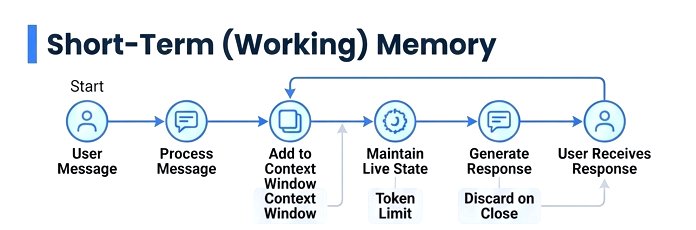
Short-term or working memory represents the agent's live context window. It is the immediate scratchpad where the active conversation or task state resides. Whenever you send a message to an AI, the incoming prompt, system instructions, and recent exchange history are loaded directly into this temporary window.
Data Flow:
- Scope: Ephemeral & session-bound ("this chat, right now").
- Storage: Model Context Window (Transformer token buffer).
- Key Mechanism: Maintains state across multi-turn prompts; automatically resets or truncates when session ends or token limits are exceeded.
- Use Case: Keeping track of immediate dialogue context and multi-step reasoning chains within an active task.
2. Long-Term Memory
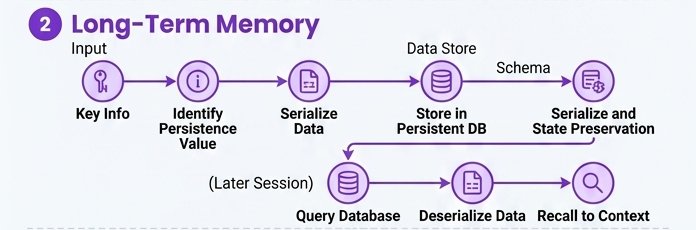
Long-term memory allows an agent to persist information across multiple sessions. Unlike working memory, which vanishes when a context window clears, long-term memory ensures an agent remembers relevant context, past states, and historical details across days, weeks, or months.
Data Flow:
Persistence Phase:
- Scope: Multi-session & persistent.
- Storage: External relational databases, key-value stores, or state management engines.
- Key Mechanism: Crucial state variables are extracted, serialized, and written to persistent storage, then fetched back into the model's active working context during subsequent sessions.
- Use Case: Project progress tracking, user settings persistence, and multi-session task state preservation.
3. Semantic Memory
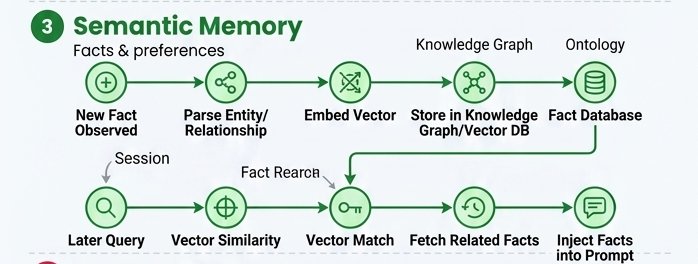
Semantic memory handles generalized facts, entity relationships, and user preferences decoupled from specific background events. It answers what is true about the user, domain, or environment (e.g., "The user prefers Python over JavaScript").
Data Flow:
Learning Phase:
- Scope: Factual, structural, and conceptual knowledge.
- Storage: Knowledge Graphs (e.g., Neo4j), relational schema stores, or vector-indexed entity tables.
- Key Mechanism: Information is parsed into discrete facts or triples (Subject-Predicate-Object), cataloged, and pulled into system prompts whenever relevant concepts are triggered.
- Use Case: Personalization engines, domain knowledge modeling, brand guidelines enforcement, and entity disambiguation.
4. Episodic Memory
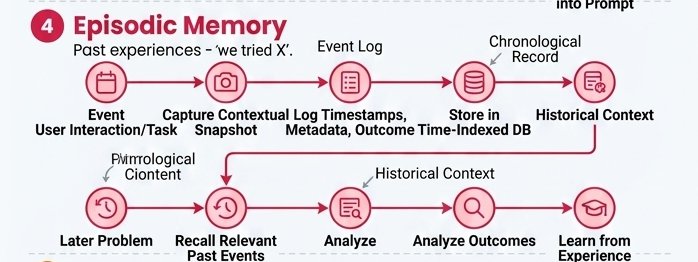
Episodic memory records past experiences and sequences of events tied to specific time markers and outcomes (e.g., "We attempted code refactoring option A on Tuesday, but it caused a dependency error"). It focuses on what happened during past execution attempts.
Data Flow:
Logging Phase:
- Scope: Chronological, experience-driven execution records.
- Storage: Time-series databases, structured execution audit logs, or append-only event streams.
- Key Mechanism: Actions, parameters, and results are timestamped and indexed into an event log. The agent queries this history to avoid repeating past errors and to replicate past successes.
- Use Case: Self-reflection loops, iterative code debugging, process optimization, and historical auditing.
5. Procedural Memory
Procedural memory stores the agent's internal skills, rules, standard operating procedures (SOPs), and execution workflows. It governs how tasks are accomplished, defining decision trees, tool routing rules, and execution paths.
Data Flow:
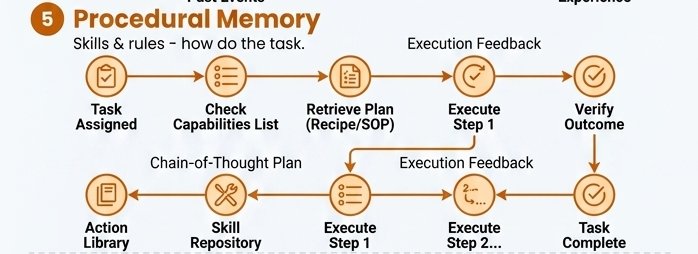
- Scope: Skill definitions, rule systems, and workflow mechanics.
- Storage: Tool schemas, system instructions, dynamic prompt libraries, or hardcoded execution graphs (e.g., LangGraph / AutoGen flows).
- Key Mechanism: Operational rules dictate how the agent breaks down complex requests into sub-tasks, evaluates conditional branches, and calls APIs or external tools.
- Use Case: Multi-step API orchestration, business logic compliance, automated decision trees, and code execution pipelines.
6. Vector / Retrieval Memory (RAG)
Vector or Retrieval memory uses high-dimensional mathematical embeddings to locate and retrieve relevant knowledge on demand using semantic similarity matching. It enables an agent to search massive knowledge bases without needing to load all data into the active prompt window at once.
Data Flow:
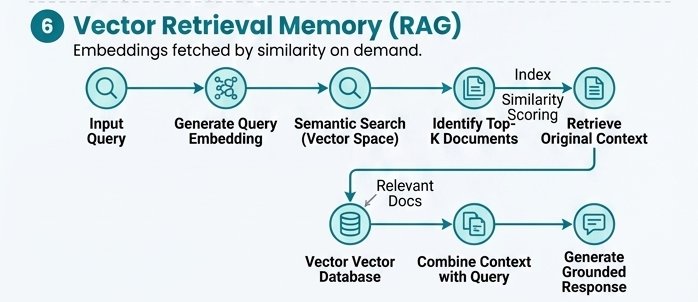
- Scope: Searchable enterprise or external knowledge store.
- Storage: Vector Databases (e.g., Pinecone, Qdrant, Milvus, Chroma).
- Key Mechanism: Text chunks are transformed into dense numerical vectors. At query time, the system compares vector angles (e.g., cosine similarity) to fetch the top-matching snippets ("Top-K") and injects them into the agent's context window.
- Use Case: Retrieval-Augmented Generation (RAG), querying massive PDF/documentation sets, knowledge base lookup, and legal/scientific literature analysis.
Summary Architecture Comparison
| Memory Type | Core Focus | Primary Storage | Key Mechanism |
|---|---|---|---|
| Short-Term (Working) | Live context & active thread | Model Context Window | Token context buffer |
| Long-Term | Cross-session continuity | External Relational DB / State Store | Serialization & state re-hydration |
| Semantic | Facts, entities, and preferences | Knowledge Graphs / Key-Value Stores | Fact extraction & prompt injection |
| Episodic | Experience history & event sequences | Time-Indexed Event Logs | Audit logging & outcome analysis |
| Procedural | Skills, SOPs, and decision rules | Tool Schemas & System Directives | Condition-action matching & tool execution |
| Vector / Retrieval | Similarity-based knowledge search | Vector Database (RAG) | Vector embedding similarity (Top-K) |