Enterprise Multi-Agent RAG & System Recommendation Platform
2025-04 – 2025-08
This project presents an advanced Multi-Agent Retrieval-Augmented Generation (RAG) architecture built to unify and streamline diverse data retrieval needs across the CCS (Crown Commercial Service) ecosystem. Instead of relying on isolated search systems, this platform centralizes enterprise queries by intelligently routing requests to domain-specific agents. It seamlessly handles complex queries across internal HR and finance data, general CCS informational inquiries, and dynamic recommendation workflows for procurement Frameworks and G-Cloud services.
Scope of the Project
- Unified Data Access: Consolidate disparate RAG applications across HR, Finance, and General CCS Information into a single, intelligent entry point.
- Intelligent Query Handling: Automatically decompose complex, compound user prompts into targeted sub-queries for precise context retrieval.
- Service & Framework Recommendations: Intelligently evaluate user requirements to return tailored top-10 ranked lists for G-Cloud services and procurement frameworks.
- Iterative Loop Synthesis & Memory: Store intermediate agent results in memory, re-evaluating sub-queries iteratively until a comprehensive final response is compiled.
Frameworks and Technologies Used
- Agentic Orchestration: LangGraph (graph-based state management, agent looping, and conditional routing)
- Large Language Models: OpenAI Models (used for agent reasoning, query decomposition, and final answer synthesis)
- Embeddings: OpenAI
text-embedding-ada-002(for semantic vector search) - Vector Store & Retrieval: Azure AI Search (enterprise document retrieval and indexing)
- Application Framework: Flask (backend API and demonstration interface)
Technical Workflow & Process
The system operates through a state-driven multi-stage pipeline powered by LangGraph:
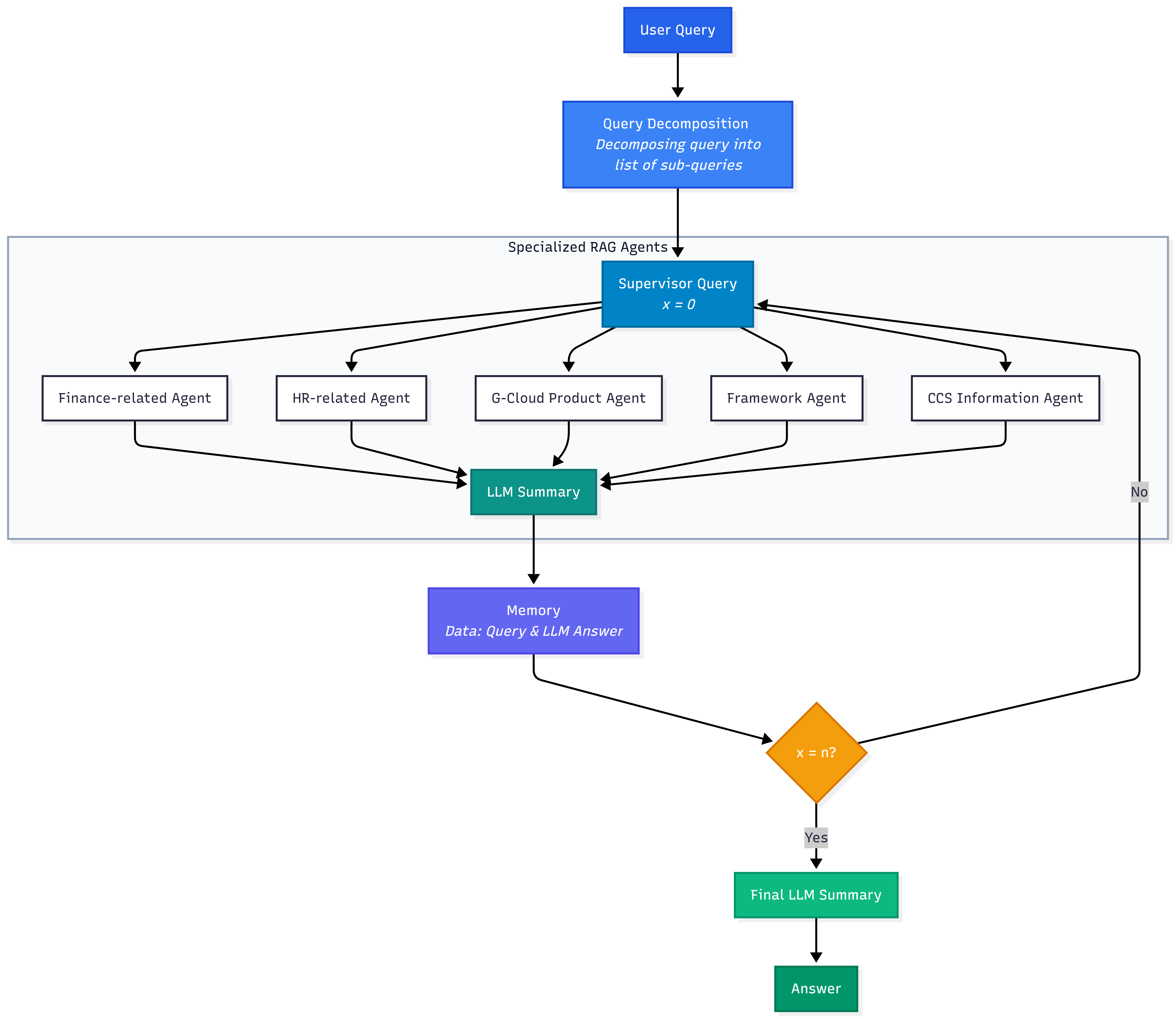
Process Steps:
-
Query Decomposition Stage: Upon receiving a user prompt, the Query Decomposition Agent analyzes the request. If the input is multifaceted (e.g., asking about an HR policy and a G-Cloud vendor simultaneously), it breaks the prompt into a structured list of targeted sub-queries.
-
Supervisor Routing & Orchestration: The Supervisor Agent initializes an execution loop ($x = 0$). It evaluates each decomposed sub-query and routes it to the relevant specialized downstream agent: * Finance Agent: Retrieves internal financial records and context via Azure AI Search. * HR Agent: Queries internal HR manuals, guidelines, and policy documentation. * G-Cloud Product Agent: Evaluates cloud service requests and outputs a ranked Top-10 list of matching G-Cloud services. * Framework Agent: Processes procurement requirements to generate a ranked Top-10 list of CCS procurement frameworks. * CCS Information Agent: Answers general administrative and organizational inquiries.
-
Sub-Context Aggregation & Memory: Outputs from all active specialized agents are gathered by an intermediate LLM Summary step and saved to Memory. This maintains execution state and preserves raw context alongside the sub-queries.
-
Iterative Evaluation ($x = n$ Check): The system evaluates whether all sub-queries in the decomposed list have been resolved ($x = n$). If pending sub-queries remain, the process loops back to the Supervisor Agent ($x = x + 1$) for the next iteration.
-
Final Synthesis & Response: Once all sub-queries are completed, the Final LLM Summary Agent retrieves the accumulated state from Memory, resolves overlapping information, and formats a single response delivered to the user.